
PIR vs Rock Wool
Different materials. Different performance. One right choice — the complete side-by-side comparison for engineers, consultants and factory owners.
Two engineered cores. Two engineering philosophies.
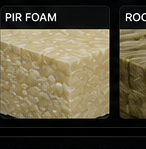
PIR (polyisocyanurate) is a rigid closed-cell foam optimised for the lowest possible U-value. Rock Wool (mineral wool) is a fibrous mineral core engineered for non-combustibility and acoustic mass. Both are laminated between PPGI steel skins in the same NEVO production line.
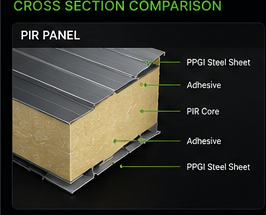
PIR Panel
Closed-cell foam- PPGI Steel Sheet
- Adhesive
- PIR Core
- Adhesive
- PPGI Steel Sheet
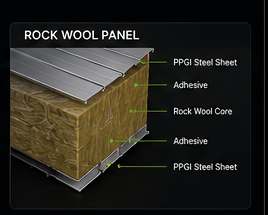
Rock Wool Panel
Mineral fibre- PPGI Steel Sheet
- Adhesive
- Rock Wool Core
- Adhesive
- PPGI Steel Sheet
Side-by-side performance table
Eleven engineering criteria. Real values from EN-tested panels.
Heat loss simulation across thicknesses
Move the thickness selector to compare live U-values, heat flux and thermal image response.
Lower U-value = Better insulation
Real-world fire performance test
Direct flame exposure. Rock Wool is A1 non-combustible. PIR is self-extinguishing (B-s2,d0) and does not propagate flame.
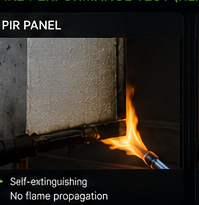
No flame propagation. B-s2,d0 EN 13501-1.
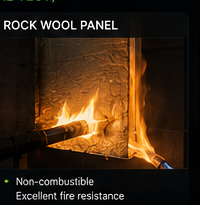
Excellent fire resistance. A1 EN 13501-1.
PIR is significantly lighter
Lower panel weight reduces structural steel, transport cost and installation crew size.
Rock Wool wins on acoustics
Fibrous mineral mass absorbs airborne sound better than closed-cell foam. Critical for offices and hotel façades.
Higher dB = Better sound insulation
Field performance metrics
Moisture Resistance
Closed-cell PIR does not wick moisture — essential for cold storage vapour barriers.
Installation Speed
Lighter panels install 20–30% faster with lower crane/rigging requirements.
Mechanical Strength
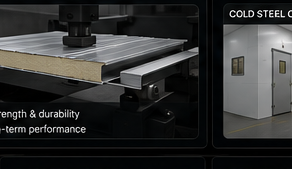
Both cores meet EN 14509 span requirements when steel skins are correctly gauged.
Which panel for your project?
Pick your building type — our engineering matrix recommends the right core.
Lowest λ, minimum heat loss, moisture resistant.
The complete economic picture
Initial Cost
PIR CAPEX is ~15% below Rock Wool at equal U-value.
Lifecycle (20 yr)
Energy savings compound over 20 years — PIR leads TCO.
Energy Saving
Vs uninsulated envelope, over 20 years.
Maintenance
Sealed skins on both; PIR edge integrity is superior.
Technical documents
Full engineering documentation, ready for your specification package.
Engineering questions, answered
Which is better, PIR or Rock Wool?
Neither is universally better. PIR delivers superior thermal performance, lower weight and lower cost — ideal for cold storage, food and warehousing. Rock Wool is non-combustible (A1) and provides better acoustics — required for high-rise façades, offices and fire-critical compartments.
What is the U-value difference at 100 mm?
PIR at 100 mm delivers ~0.22 W/m²K, Rock Wool ~0.34 W/m²K. PIR is roughly 35% more thermally efficient at the same thickness.
Is Rock Wool fireproof?
Rock Wool is classified A1 non-combustible per EN 13501-1 — it does not burn, does not release smoke and withstands >1000°C. PIR is B-s2,d0 and self-extinguishing but combustible under sustained flame.
How much heavier is Rock Wool?
A 100 mm Rock Wool panel weighs ~16.8 kg/m² vs ~10.2 kg/m² for PIR — Rock Wool is ~65% heavier, affecting structure, transport and installation.
Which panel installs faster?
PIR installs 20–30% faster due to lower weight and lighter handling. Rock Wool requires more crew and rigging for the same area.
What is the lifecycle cost difference?
PIR has ~15% lower CAPEX and 20–30% lower energy cost over 20 years. Rock Wool has a longer service life (30–40 yrs vs 25–30 yrs) and better residual value in fire-rated buildings.
Let a NEVO engineer specify the right panel for your project.
Free 30-minute engineering consultation. Send us your project brief and receive a specification pack within 24 hours.